


The CTA Violates Its Own Constitution
On September 2, 1960, the year after the Dalai Lama escaped from Tibet into India, His Holiness declared a democracy for the Tibetan people in exile. It was an important landmark after centuries of theocratic feudalism dominated the social and political landscape of the Himalayan nation. The Dalai Lama’s declaration had wide appeal around the world and the Tibetan Cause was henceforth to be a fight for the Tibetan people’s freedom and rights by its democratic government against the oppression of a totalitarian regime. In that way, the Tibetans’ plight seduced the libertarian West.

The underlying understanding of a democracy is that the government is formed only to represent and serve the people; otherwise it has no need for itself. This guarantee is enshrined in a social agreement between the people and their elected representatives, known as the Constitution, which embodies the highest law. On March 10th 1963, His Holiness the Dalai Lama formally decreed the Tibetan Constitution.

The Tibetan Constitution sets out a framework of governance that compels all Tibetans regardless of who they are, what stature in society they occupy and what office they hold, to abide by this highest law. A law that protects the rights and interests of all people and that which prohibits the government, once in power, from infringing on the rights of the citizens they are supposed to represent. Once elected, the government of the Tibetans-in-exile, now known as the CTA, becomes the immediate authority over the general population and it is commonsense therefore that how the CTA treats the sacrosanctity of their Constitution is indicative of the value they place on it – which by the way, is the only instrument of law higher than the government. It becomes the yardstick by which the sincerity of the CTA to serve and advance the welfare of the Tibetan people is measured.

In addition, in His Holiness’s Foreword in the Tibetan Constitution, the Dalai Lama stated that the Tibetan charter takes into consideration doctrines enunciated by Lord Buddha as well as the spiritual heritage of Tibet. Accordingly the level of importance the CTA places on its Constitution is also indicative of their respect for the Tibetan Buddhist culture which is the legacy bestowed upon the people by centuries of highly attained lamas and masters.

In the case of the Tibetans in exile (and all Tibetans ultimately, should the Tibetans regain their independence), these two measures are exceptionally crucial because the Constitution effectively replaces the Dalai Lama as the highest authority to guide, champion and protect the future of the Tibetans. So the question that follows is how well has the CTA preserved the Tibetan Constitution and how closely have they abided by that which will take the people into the future as a free and democratic nation?

It is against this lens of scrutiny that a worrying tale emerges of how the Tibetan Constitution has been violated by the very people charged to preserve it. To illustrate, reference will be made to a few key Articles in the Tibetan Constitution and against them we examine actions and decisions made by the CTA that has had repercussions till this day.

Article 12 of the Tibetan Constitution guarantees that:
- All religious denominations are equal before the law.
- Every Tibetan shall have the right to freedom of thought, conscience and religion. The right includes freedom to openly believe, practice, worship and observe any religion either alone or in community with others.
- Freedom to manifest one’s religion or beliefs and to deal with any matter relating to religious or charitable purpose either alone or in community with others shall be subject only to such limitations as are prescribed by law and are necessary in the interests of public safety, for the protection of public order, health or morals, or for the protection of the rights and freedoms of others.
Article 12 was first formulated in 1963 and has been reaffirmed by the Tibetan government at each review over the decades until today. Yet just three decades after the Constitution was drafted and announced, in 1996, the CTA decreed a ban on the practice of a Buddhist deity, Dorje Shugden, that is a core practice of the Gelugpa lineage, a practice that has prevailed for over 350 years. In May of that year, the Tibetan Cabinet (Kashag) issued a formal declaration that amongst other things stated:
It is the duty of the Tibetan Government-in-exile to encourage compliance with any advice given out of concern for the cause of Tibet, the security of its head of state and the honor of all Tibetan Buddhist traditions including the Geluk tradition. Consequently, it has initiated a programme to be prevailing upon those still following Dolgyal [a derogatory name for Dorje Shugden] to make a break with it.
Not only was it illegal for the CTA to ban a Buddhist practice but also, no reason whatsoever was given for the ban nor was there any dialogue with the people whom such a ban would seriously affect. Tibetan Buddhism is collectively defined by the individual practices of a few main Buddhist schools, each with its own tradition and time-honoured veneration of selected deities and customs. It is not the role or authority of any one particular lineage or even the government to dictate the religious affairs of any of the schools. And yet, practically overnight, the practice of Dorje Shugden was simply outlawed.

The statement by the Kashag speaks of its “duty” and here the government seriously erred, for its first and foremost duty was to protect the liberty of its own people including their freedom to practice their own religion as provided for by Article 12 of the Constitution. It also made reference to “advice” which presumably was advice given by the Dalai Lama which in itself begs another question – can the advice of the Dalai Lama translate into law that the government is then under a duty to enforce compliance of?

Granted that at that time the Dalai Lama was both the spiritual and political head of the Tibetan people in exile, but does His Holiness’ words amount to law that is higher than the Constitution? If that is so, then there is no democracy but a system more analogous to a dictatorship or theocracy, which means that the Tibetan Constitution is in truth, only an instrument of fraud, created to swindle the Tibetan public and the rest of the world into supporting its government. In a true democracy, under no circumstances can the advice of an individual override the highest law of the land without cause and due process. On this alone, the CTA proves itself not to be a democratic government.
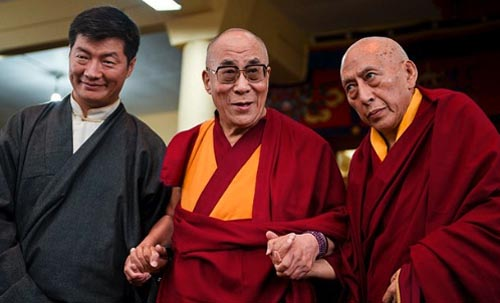
The Dorje Shugden ban had serious and far-reaching repercussions and many lives were affected. The aftermath of that declaration by the CTA was wave after torrid wave of deceitful propaganda, each deploying unknowing citizens on a zealous rampage to seek out Dorje Shugden practitioners and monks who were labeled enemies of the state. Tibetan lives were destroyed, as were religious traditions that had survived the centuries. Schisms grew from within the monastic community as Shugden practicing monks were forced to denounce their own spiritual teacher and Dharma Protector (which is viewed as nothing short of committing spiritual suicide) or be expelled. All these destroyed the rich Tibetan Buddhist culture (which ironically the CTA is accusing China of doing) that had held the people together. And the most terrible blow the CTA inflicted with this prohibition was on the hopes of the Tibetan people in regaining their nation, for before long the ban would reveal the Tibetan people’s fight for freedom and liberty to be a false dream.

By virtue of the ban, all Shugden practitioners were treated as outcasts and not allowed to live communally with their fellow exiles. They were also prohibited from voting and participating in any election, which violates Article 20 of the Tibetan Constitution that states:
All Tibetans, men and women, who have attained the age of eighteen and above shall have the right to vote. The vote shall be personal, equal, free, and secret, and its exercise shall be deemed to be a civic obligation.
The Dorje Shugden ban forced upon the Tibetan society a new class of social and spiritual pariahs, and destroyed the credibility of Article 8 that provided for all Tibetans to be equal before the law without discrimination on any ground such as sex, race, language, religion, social origin, property, birth or other status.
This case is not the first violation by a government of its own Constitution but true democracies have built-in safeguards such as the separation of powers between the Legislature (the Parliament), the Executive (Civic bodies) and the Judiciary (Courts of law). However, in the case of the Dorje Shugden ban, the façade of democracy was shamelessly lifted to reveal that indeed there was no such separation, and the Judiciary proved impotent against the will of the governing elite who most likely appointed the members of the Judiciary. With that, Article 24 of the Constitution was rendered redundant. Article 24 states:
Every citizen whose rights and freedoms as set forth in this Chapter are violated shall have the right to approach the Supreme Court, Regional Courts and such other courts as the National Assembly may by a law designate for the enforcement of those rights and freedoms enumerated in this Chapter and the Court shall be entitled to pass such orders as are necessary to protect those rights.
The CTA’s ban on the Shugden practice is an unmitigated calamity to the credibility of the Tibetan Cause and exposes the CTA to be the Tibetan people’s main obstacle in their quest for freedom. China may have taken a country away from the Tibetans but that is merely geography. What is more important are the people, their lives, dreams, hopes, faith, trust, religion and future. China did not rob the Tibetans of those treasures, but the CTA did.

And irony of ironies, the present Prime Minister of the exiled Tibetan people, Dr. Lobsang Sangay, is a holder of a doctorate degree in human rights who professed to be a champion of democracy. Not long after he was elected into the very power that maintains the religious ban, the website of the CTA carried this news in January 2012:
“Only democracy can resolve the issue of Tibet,” said Kalon Tripa Dr Lobsang Sangay at ‘Democracy in Exile: The case of Tibet’, a public lecture organised by the Jindal School of International Affairs on Thursday in Sonepat.He also said that if China allowed more religious and cultural freedom as well as democratic governance in Tibet, it could resolve the issue of Tibet.
Kalon Tripa praised India’s own democratic traditions and said the Central Tibetan Administration, based in Dharamsala, had been inspired to follow the same traditions.
He said, we Tibetans, have learnt many essential traits from India’s great democracy and are implementing them in exile especially the commitment to resolve social issues through dialogue and the flourish of a ethical and vibrant media.
While Lobsang Sangay may not have been the Prime Minister of the CTA when the ban was effected, he is most certainly occupying the highest ranking seat in Parliament today, which empowers him to reverse the injustice. And yet he has not. Until such time when the Dorje Shugden ban is removed and the CTA behaves like a truly democratic government, it will be wise for all to remember an old legal maxim whenever one reads statements from the Tibetan government, Caveat emptor.
Category:
Thank you for your sharing. I am worried that I lack creative ideas. It is your article that makes me full of hope. Thank you. But, I have a question, can you help me?
Your point of view caught my eye and was very interesting. Thanks. I have a question for you.
Thanks for sharing. I read many of your blog posts, cool, your blog is very good. https://www.binance.info/register?ref=QCGZMHR6
I don’t think the title of your article matches the content lol. Just kidding, mainly because I had some doubts after reading the article. https://www.binance.bh/register?ref=W49FLGDN
Thanks for sharing. I read many of your blog posts, cool, your blog is very good.