


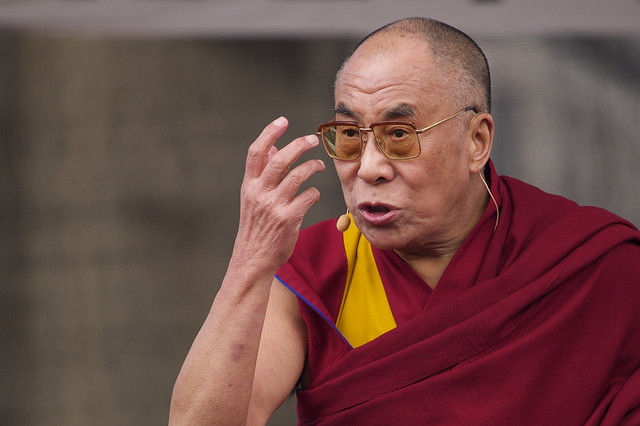
No, Dalai Lama is Not a Creep, But He’s Definitely Sexist
We should be talking about how ignorant and unaware this renowned spiritual leader is when it comes to women’s equality.
Dalai Lama has continuously referred to his first encounter with a Paris editor when asked whether a female could succeed him as a Dalai Lama.
In 1992, the then-Paris editor of Vogue Magazine invited the Dalai Lama to guest-edit the next edition.
She asked if a future Dalai Lama could be a woman, to which he responded, “Certainly if that would be more helpful,” adding that they should be more attractive.
Since then, he has uttered this nonsense numerous times in interviews.
In 2007, he agreed that the next Dalai Lamai could be a woman, saying, “If a woman reveals herself as more useful, the lama could very well be reincarnated in this form.”
Then in 2010, journalist Larry King asked him the same question. Dalai Lama responded it was “very possible’” that a female could replace him, citing that in Tibetan tradition, there are females in high positions.
Then he leaned toward Larry King as if he was going to tell him a secret, “If female Dalai Lama comes, the female must be very, very attractive,” to which Larry snickers. Dalai Lama adds, “more useful,” to which both men giggle like bros talking at a water cooler.
He didn’t stop there. In 2015, a male reporter for BBC asked, “Is there going to be a 15th reincarnation after you?
Dalai Lama said that it depends on the Tibetan people. The reporter then asks if it could be a woman, to which the Dalai Lama recounted the same incident in Paris.
He said that in today’s troubled world, it would make sense to have women in more important roles because they have the biological capacity to show compassion.
Then he grabbed the reporter’s hand, leaned in, and said, “Then I told that reporter if female Dalai Lama comes, the face must be very, very…should be very attractive.” They both broke out in laughter.
The reporter asks, “So you can only have a female Dalai Lama if they’re attractive?”
Dalai Lama repeats, “If a female Dalai Lama comes, then female must be attractive, otherwise, not much use.”
The reporter raises his eyebrows and says, “You’re joking, I’m assuming or you’re not joking?”
“I mean…true.” Dalai Lama responds with a straight face.
In the same year, a female BBC reporter asked the Dalai Lama to confirm his previous statement about women:
“You also told one of my colleagues that that female must be attractive otherwise, it’s not much use. Can you see why that comment upset a lot of women?”
The Dalai Lama responded, “If female Dalai Lama comes, then should be more attractive. If female Dalai Lama (scrunches his face and snickers), then people, I think, prefer not to see that face.”
Then he said women should “spend money on makeup.”
“A lot of women would say that’s objectifying women. It’s who you’re on the inside, isnt’ it?” The reporter asks.
“I think both,” he says. “Real beauty is inner beauty, that’s true, but I think appearance is also important.”
No matter how one dissects this, it’s easy to see that the Dalai Lama sees that women are only useful if they can prove to be more useful.
The more I watched his many interviews, the more it became clear that Dalai Lama is a product of a patriarchal religious organization. Women have made headway when it comes to flying into space, becoming world leaders, and have won every category of the Nobel Prize.
Yet religion is one area where women have not made much progress. In the world’s major religions, women have been denied the right to serve in leadership positions and barred from ordination.
Some are forbidden from praying alongside men and stepping inside houses of worship.
Sexism in Buddhism is nothing new. Tibetan culture is quite patriarchal. Tibetan Buddhism doesn’t allow women to achieve the same religious status as men. It denies them the highest-ranking ordination, called bhikkhuni.
But the Dalai Lama has been widely credited for making Geshema degree — considered equivalent to a Ph.D. degree in Tibetan Buddhism — available to nuns for the first time.
It involves four years of “written and debate exams” plus the “completion and defense of a thesis.” It’s so rigorous that it takes 17 years of study to simply be eligible to take the Geshema exams.
Why then would Dalai Lama keep repeating the same mistake and talking about women in this way? Doesn’t he know that our ancestors have fought hard to have the same rights as men?
Is he so secluded in his own world that he cannot see that women globally would take offense to such comments, especially from a spiritual leader?
Your point of view caught my eye and was very interesting. Thanks. I have a question for you.
Your article helped me a lot, is there any more related content? Thanks!